
Chennai oil spill: Centre claims 90% of clean-up work over
Chennai Port and Tamil Nadu government have organised medical camps today at Ernavoor and Kasimedu fisheries harbour.
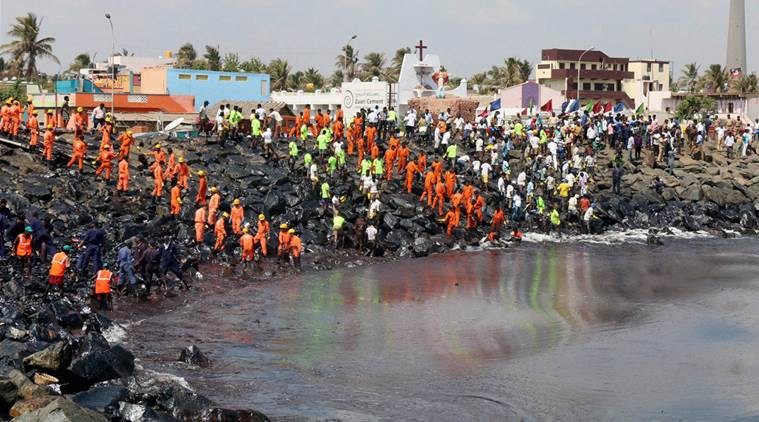
With the oil spill off the coast here raising concerns, the Centre
today said a total of 65 tonnes of sludge has been removed so far and
over 90 per cent of the work completed. It also expressed confidence
that the cleaning operation will be finished in a couple of days. Among
others, the Indian Oil Corporation (IOC) was providing special
bio-remediation material for treatment of the collected oil sludge for
safe disposal.
“The total quantity of sludge which was removed till February 2 was
65 tonnes. It is observed that there is a vast difference between
quantity of oil spilt and sludge recovered due to the fact that the oil
gets coagulated and becomes puffy when it is recovered with water and
sand,” an official release said. “More than 90 percent of the work has
been completed and most of the residual work is expected to be completed
in a couple of days,” it said.
Further, ‘Super Suckers’ had removed 54 tonnes which contained 70 per
cent water, it added. “The Indian Oil Corporation has provided special
bio-remediation material for treatment of the collected oil sludge for
its safe disposal. “HPCL has arranged for trailers and manpower for
transporting collected sludge to Ennore port area for bio remediation
treatment under the expert guidance of IOC R&D experts where 2000
Sq.M. pit has been created for the purpose,” the release said.
Chennai Port and Tamil Nadu government have organised medical camps
today at Ernavoor and Kasimedu fisheries harbour. On January 28, two
shipping vessels had collided outside the Kamarajar Port at Ennore,
resulting in rupture for one of them which led to an oil spill. The
release stated that as soon as the oil leak was tracked, the Coast Guard
started mobilising equipment and manpower for clean-up at various
locations and coordinated the operations.
Animal rights campaigner alleges elephant torture in local temple fest
Violating the rules, a blind elephant was also paraded as part of the 'Cheerakuzhi shasti', a local festival two days ago, the HATF alleged.
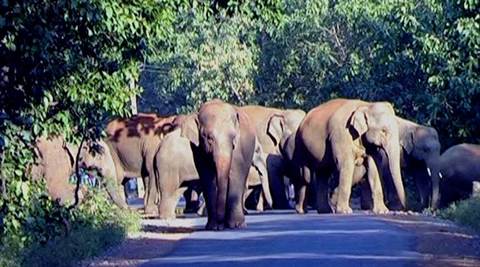
Heritage Animal Taskforce, a state-based animal rights campaigner, has
alleged that as many as 24 elephants were ‘tortured’ by compelling them
to walk in the scorching sun as part of a recent temple festival in
Thrissur district. Violating the rules, a blind elephant was also
paraded as part of the ‘Cheerakuzhi shasti’, a local festival two days
ago, the HATF alleged. “As many as 24 elephants were abused at this
place from 11 AM to 7 PM compelling them to walk under scorching
sunlight through tarred road of state highway,” the outfit said in its
complaint to the Director, Project Elephant, MoEF, New Delhi.
This type of performance is a quite violation of Wildlife
Protection Act 1972 and Performing Animals Registration Rule 2001 and
Prevention of Cruelty to Animals Act 1960,” HATF secretary V K
Venkitachalam said. He also alleged that the blind elephant,
Thechikottukavu Ramachandran which was paraded, has a track history of
killing 11 people and three elephants.
“As per the elephant parade rules, it is unlawful to parade blind
elephants. Parading of jumbos between 11 AM to 4 PM is also an unlawful
activity. All these illegal activities occurred when the day temperature
was 40 degree Celsius,” he said.
The activist asked the authorities to initiate penal action against
those responsible for “this type of organised crime” against elephants.
JNU tweaks admission policy for MPhil, PhD after protests
The university had last December approved amendments in the admission policy giving 100 per cent weightage to viva voce and reducing entrance examination as a qualifying criteria.

Following protests from students, JNU has decided that the admission
policy for MPhil and PhD programmes will continue to have a weightage of
80 per cent for entrance exam and 20 per cent for viva voce. The
university had last December approved amendments in the admission policy
giving 100 per cent weightage to viva voce and reducing entrance
examination as a qualifying criteria. The amendments had attracted
consecutive protest demonstrations from students.
“The admission policy would adhere to all constitutional provisions
related to reservation system. There should be a three-tier entrance
test consisting of a qualifying test where all students need to get 50
per cent for moving on to the next stage of descriptive type written
test and viva voce,” the steering committee of admission at JNU said.
“The ratio of weightage for descriptive type written test and viva
voce should be 80:20. Legal opinion should be taken on applying
reservation system at the first qualifying test where the qualifying
marks is 50 per cent,” it added. The decision was taken at a meeting of
the Steering Committee of admission of JNU to discuss the relevant
portions of new regulations and its impact on the current practices of
the university.
Paytm, Reliance Jio served govt notice for using PM Modi’s image in ads
Heavy criticism was lashed at the government after PM Modi's photographs were used in Paytm and Reliance Jio advertisements.

Paytm and Reliance Jio Infocomm were served with notices by the government for using Prime Minister Narendra Modi photograph in their advertisements, reported Economic Times on Saturday. The Ministry of Consumer Affairs, Food and Public distribution has asked the companies whether they had taken prior permission before using the photograph. According to the report, three unnamed officials from the department confirmed the move.
Apart from this, the consumer affairs department has also reportedly
advised the ministry of information and broadcasting to sensitise the
media on the need to obtain “prior permission” before commercial usage
of specific emblems and names prohibited by the The Emblems and Names
(Prevention of Improper Use) Act, 1950. While Paytm had earlier
applauded PM Modi’s demonetisation decision urging people to switch to
digital transactions, Reliance Jio had claimed it was furthering the
government’s ‘Digital India’ move.
The two companies came under severe criticism as many lashed out at
the move. Last year, Congress vice-president Rahul Gandhi referred to
PayTM — the payment gateway has seen a huge growth in numbers since the
November 8 announcement — as “Pay to Modi”. “That is the idea behind a
cashless economy. That a few people should get maximum benefit from
every transaction. That is what is going on,” Rahul said. Hitting out at
Modi over demonetisation, West Bengal CM Mamata Banerji
had said, “India’s prime minister has become a salesman for a
company(Paytm), 40% shares of which are owned by a blacklisted Chinese
company.”

No comments:
Post a Comment